
I'm Joe Gonzales. I run EXPI Athletics in Ontario, and I coach at San Bernardino Valley College. This blog is where I explain how I coach and what we're learning. Plain words. No hype.
First post, so let's start with the swing and how I coach it.
Here's the whole thing in one line: good back hip, strong front foot, hands on the line.
That's it. If you remember nothing else from this post, remember those three.
How I think about coaching
I think a good hitting coach takes the approach of a super successful business executive. Simplicity is key. Experience, knowledge, no ego, and always constantly wanting to learn.
Simple matters. A hitter can't think about ten things in the box. The pitch is on him too fast for that. My job is to give him a few things he can own, rep them until they're his, and get out of the way.
I'm a directional coach
This is where I'm different from a lot of coaches, so I'll say it plainly. As a hitter, I don't teach the swing as rotation. I'm a directional coach. Everything I teach is about transferring force directly toward the pitcher.
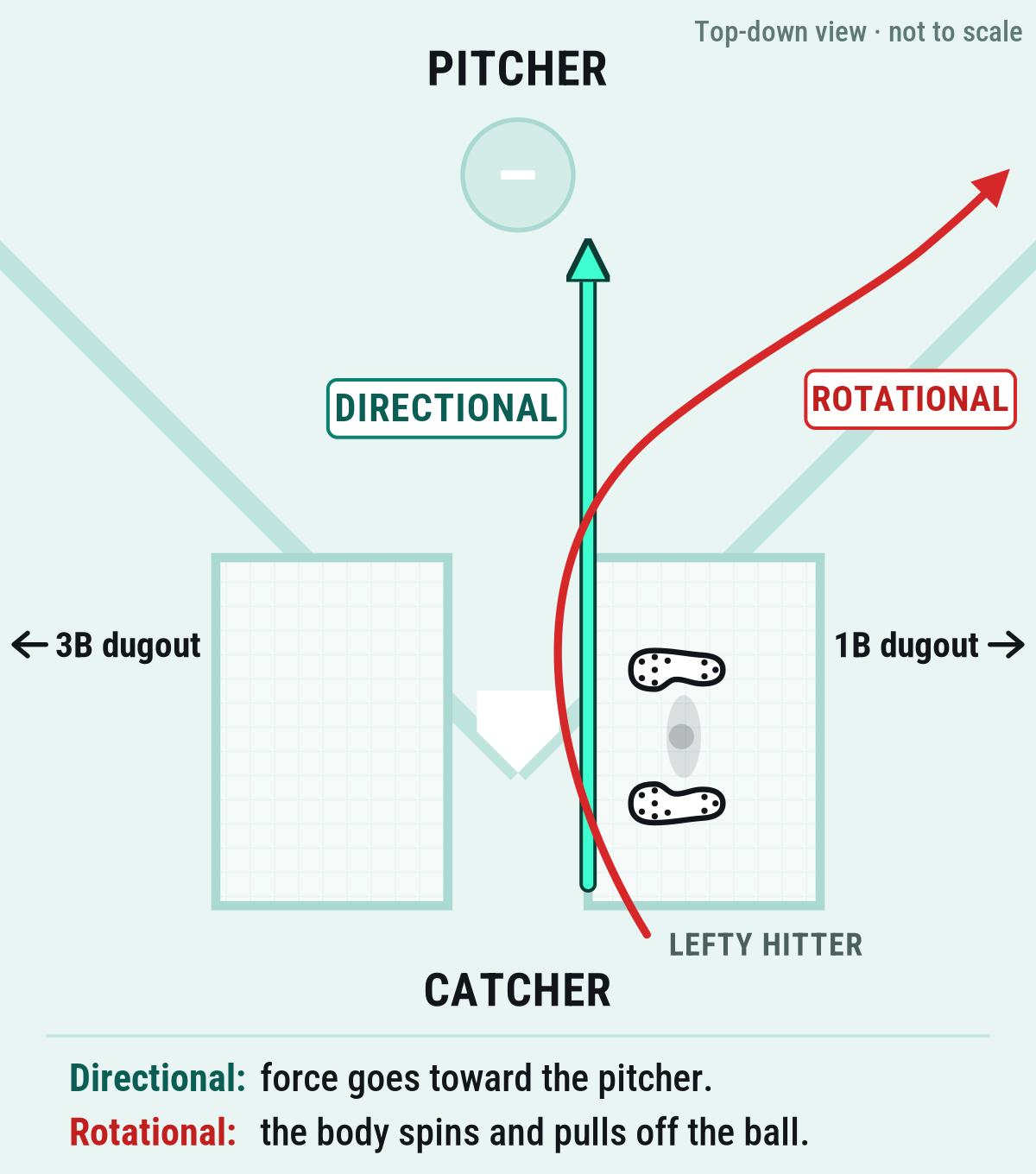
The three cues all serve that one goal.
1. Good back hip
It starts with a good back hip and internal rotation. First cue, first thing to get right.
When I say internal rotation, I'm talking about the back hip, not the swing. You have to internally rotate the back hip. That's how you load the back hip. So it's not me teaching rotation as a hitter. It's how the back hip gets loaded before you move toward the pitcher.
Internally rotating the back hip is the scientific term for loading the back hip.
Here's exactly what I tell kids. For me, as a lefty, sticking my left butt cheek out helps me get into my back hip. Then I say, "Get your weight into the back hip." Another cue I use is, "Get your weight into your back heel."
If you hit right-handed, it's your right butt cheek. It's always the back hip.
This is one of my huge coaching cues:
While the lower half loads, the upper body stays directionally pointing toward the pitcher.
Think about a soccer player. He runs down the field, but he kicks the ball to the right. His upper body and lower body are doing two different things at the same time. A hitter does the same thing. The hips load while the upper body stays directionally pointing toward the pitcher.
2. Strong front foot
Use your entire front foot. Most people don't emphasize this enough. It's one of the keys.
A lot of hitting talk is about the hands, the barrel, and the back side. The front foot gets skipped. I think that's a mistake. If you want to send force toward the pitcher, the front foot has to be strong and the whole foot has to be working.
I always tell people power is the ability to stop force. We have no power unless we're able to stop everything during the swing with the front foot.
That stop starts the whole kinetic chain: power moving from the ground up and eventually into our hands.
That's still directional. The front foot isn't there to help you spin. It's there to stop the force so it goes toward the pitcher.
3. Hands on the line
Use the white lines in the batter's box.
Keep the hands down the line as long as possible. That keeps the barrel in the strike zone as long as possible. More time with the barrel in the zone means more chances to square up the ball.
What this means if you train with me
You're going to hear the same three things over and over: good back hip, strong front foot, hands on the line. That's on purpose. Simple is how it sticks.
You're not going to hear me tell you to spin harder or turn faster. You're going to hear me ask where your force is going. The answer I want is toward the pitcher.
Where the data fits
I said a good coach is always constantly wanting to learn. That includes testing my own coaching. TrackMan hitting sessions are coming soon. The scorecard is already built. It will track things like exit velocity, launch angle, contact, results on inside, middle and outside pitches, and whether the ball went pull, center or opposite field.
I'm not going to tell you those numbers prove anything about my three cues. We don't have them yet. But that's the point of tracking it. If what I teach works, it should show up over time in how the ball comes off the bat. If something doesn't, I want to know, and I'll change it. No ego.
One more thing. I teach with feel. I try not to teach with my mouth. More on that in the next post.
Your turn
Agree, disagree, or think I'm crazy? I want to hear it. Any and all comments on this post are greatly appreciated, and every one helps me make the next one better.
Then tell me this:
Players: which of the three is hardest for you right now, the back hip, the front foot, or the hands?
Coaches and parents: what's the one simple cue that's worked best for your hitters?
Joe
Responses
Be the first to respond.