
I've been saying this for years. Now MLB has proven, with statistics, my words.
Here's what I mean.
What MLB is measuring
Baseball Savant is MLB's Statcast site, and it tracks the bat on every swing. In May 2025, MLB released new swing metrics on Savant, including swing path (tilt), attack angle, and attack direction. The bat tracking data goes back to the 2023 All-Star break.
There are three to know:
- Attack angle is "the vertical direction that the sweet spot of the bat is traveling at the moment it hits the baseball." MLB calls 5° to 20° the "ideal" range.
- Swing path (tilt) is the angle of the bat's path in the 40 milliseconds before contact. It tells you how steep or flat the swing is on the way to the ball.
- Attack direction is "the horizontal direction that the sweet spot of the bat is moving at the point of contact with the baseball."
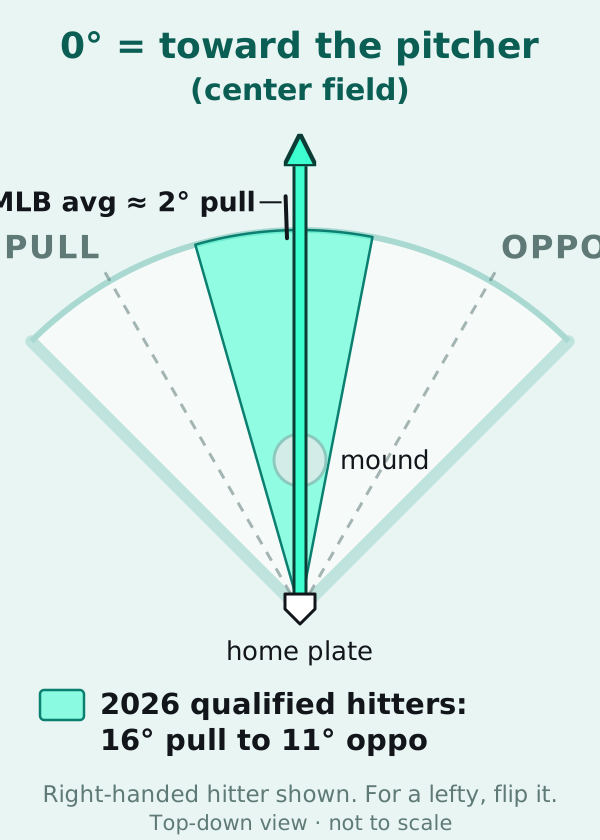
Attack direction is the one I care about. MLB measures it against an imaginary line from home plate to center field. At 0°, the barrel is moving right at center field. Anything else gets reported as degrees "pull" or "oppo." For a right-handed hitter, pull means toward left field. For a lefty, it means toward right field.
What the numbers say
MLB's glossary puts the big-league average attack direction at about 2° pull. I pulled the 2026 Savant leaderboard on September 26, 2026, and the qualified hitters' season averages ran from 16° pull to 11° oppo.
Think about that line from home plate to center field. It runs right through the pitcher's mound. So at contact, the average big-league barrel is moving within a couple of degrees of the pitcher.
One honest note. MLB says attack direction is tied to timing. An early swing tends to show more pull, and if you're late, you can't have a pull attack direction. MLB also calls it a description of hitting style, not a grade of good or bad. So I'm not saying this number proves my method makes anyone better. What I'm saying is that MLB now measures what I've been coaching.
How I coach it
I'm a directional coach. As a hitter, I don't teach rotation in the swing. Everything I teach is about transferring force directly toward the pitcher.
Good back hip and internal rotation. You have to internally rotate the back hip. That's how you load the back hip. While the lower half loads, the upper body stays directionally pointing toward the pitcher. Think about a soccer player. He runs down the field, but he kicks the ball to the right. His upper body and lower body are doing two different things at the same time.
Strong front foot. Use your entire front foot. I always tell people power is the ability to stop force. That stop starts the whole kinetic chain, with power moving from the ground up and eventually into our hands.
Hands down the line. Use the white lines in the batter's box. Keep the hands down the line as long as possible, which keeps the barrel in the strike zone as long as possible.
Good back hip, strong front foot, hands on the line. All three have the same goal: force going toward the pitcher.
Your turn
Players: the next time you hit, pay attention to where your barrel is going at contact. Is it toward the pitcher, or off to the side? Coaches and parents: do you teach directional, rotational, or a mix? Tell me in the comments.
Joe
Sources
- Baseball Savant, Swing Path/Attack Angle Leaderboard (definitions and 2026 qualified-hitter data, pulled Sep 26, 2026, 6:07 AM PT): https://baseballsavant.mlb.com/leaderboard/bat-tracking/swing-path-attack-angle
- Baseball Savant, Statcast Search CSV Documentation (attack_angle, attack_direction, swing_path_tilt): https://baseballsavant.mlb.com/csv-docs
- MLB.com Glossary, Attack Direction: https://www.mlb.com/glossary/statcast/attack-direction
- MLB.com Glossary, Attack Angle: https://www.mlb.com/glossary/statcast/attack-angle
- MLB.com Glossary, Swing Path (Tilt): https://www.mlb.com/glossary/statcast/swing-path-tilt
- Mike Petriello, "4 new swing metrics tell us more than we've ever known about contact," MLB.com, published May 19, 2025, 9:04 PM PT (2025-05-20 04:04 UTC): https://www.mlb.com/news/new-statcast-swing-metrics-2025
Responses
Be the first to respond.