
Names in this post are changed for privacy.
Marcus is an outfielder. He first came into the garage on June 18 for a Proteus test. On August 28, 71 days later, he came back and took the same test again. This is the whole story: what the first test showed, what we did about it, and what the retest said.
The first test: what June showed us
The Proteus test runs a player through several movements. For each one, it records power (how fast he does work in the movement), acceleration (how quickly he gets it moving), and consistency (how repeatable his reps are). That's what I mean by Proteus power and velocity data.
Here's what Marcus's June numbers said.
Where he was strong: his trunk rotation. Both sides moved well and moved about the same. His power was 270.6 watts on one side and 264.4 on the other. It was also one of his most repeatable movements, at 86.8% and 89.4% consistency. A player who is that even from side to side, and that repeatable, has a good base to build on.
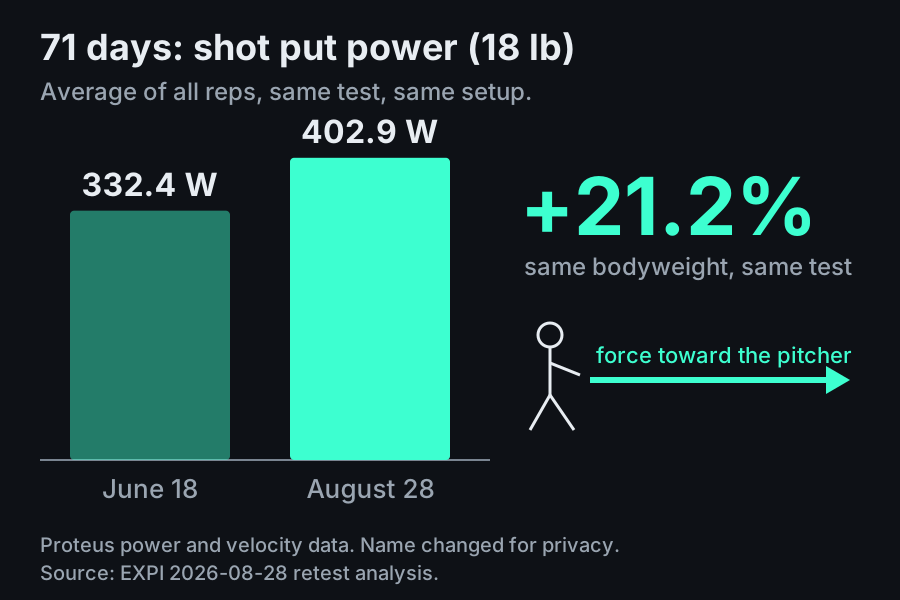
What stood out: the shot put. The shot put is done at 18 pounds of resistance. Marcus averaged 332.4 watts with an acceleration of 12.69 m/s². The number that caught my eye was his consistency: 69.8%. That was the lowest of any movement we could measure on him. Every other movement we could measure came in between 80.5% and 89.4%.
In plain words, his best shot put rep was 350.7 watts, but he couldn't repeat it consistently. Some reps were good and some weren't. A player like that has more in him than his average shows, but he can't count on it yet.
What we couldn't measure well: his jump. The vertical jump only recorded two reps in June, which is too thin to trust. His summer program still listed the jump as a first priority. On retest day the jump station had trouble for the whole group, so there's no fair before-and-after for his jump, and we don't count it.
The plan: built for him, not copied
I'm not going to post the whole program. That's his. But I'll tell you how I think about it, and what his shot put work looked like.
Every EXPI plan starts from the player's own test numbers. The June group shared the same weekly layout, but each player's version was set by his own numbers, and we don't change a plan just to make it look different. We look at what the test says is already working, what's holding him back, and what we couldn't measure, and the plan answers those things.
We found that Marcus's best shot put rep was below average for his age group (43rd percentile), and his reps weren't repeatable. His best rep was 350.7 watts, but his consistency was 69.8%, the lowest of any movement he did. The shot put got work every week. One lift day every week started with medicine ball throws before he touched a weight: half-kneeling anti-rotation shot puts and split-stance scoop tosses early in the summer, then rotational and step-back scoop tosses, and by late August, rotational shot puts with a 10-pound ball at full effort. After the throws came the landmine rotational press and low-to-high cable chops, and on another day he threw a 6- to 8-pound med ball rotationally. None of it is fancy. It's the same throw done right, week after week, and most people won't do it.
The report and plan are drafted by AI agents working from a shared rule book that gets better after every test and retest. I read and approve every one before it goes out. The agents keep the numbers honest and the paperwork fast. The coaching decisions are mine.
The work: he did it as written
This part doesn't show up on a graph, but it matters most. Marcus did the program as written through the first two sessions of week 10 of 12, which is where he was when he retested. When a player does the work the way it's laid out, the retest tells you whether the plan was right. When he doesn't, it just tells you he didn't do it.
The retest: 71 days later
On August 28 he tested again: same test, same weights, same setup.
Shot put power: 332.4 to 402.9 watts. That's +21.2% in 71 days.
His acceleration on the same throw went from 12.69 to 14.80 m/s² (+16.6%). He didn't just push harder. He accelerated it faster.
And the number that bothered me in June, his shot put consistency, went from 69.8% to 85.5%. That was the weakest part of his first test, and it came up to where his other movements already were.
It wasn't only the shot put. Power improved on every movement we could validly measure: five of five measurements, counting each side of the trunk rotation. His trunk rotation power went up on both sides (+8.5% and +7.9%), and the D2 flexion arm pattern gained 15.7% in power. The jump station had trouble on retest day for the whole group, so the jump is left out again. It doesn't count for him or against him.
When power, speed, and consistency all move up together on the same movement, that's hard to fake. It's hard to get that from one lucky day.
How we know it's a fair comparison
This is the part I trust the most.
- Same test both times. Same session type, same resistance, same attachment.
- Matched on his Proteus ID, not by typing his name, so we know it's his data both times.
- Bodyweight didn't change. He was 180 pounds at both tests, so the gain isn't just a heavier player.
- Averages compared to averages. Proteus records every rep. We compare his June average to his August average. We don't compare his best rep to his best rep, because one great rep can hide a lot.
If any of those don't line up, we don't call it a gain. We call it "we don't know yet" and test again.
What the retest told us next
A retest isn't just a report card. It also tells us where to go next. Marcus's trunk rotation is still faster than his shot put. The speed is there, and not all of it is getting into the ball yet. So his next block is aimed at getting more of that speed into the ball. The goal is the same thing I teach in the box: good back hip, strong front foot, hands on the line, and the force going toward the pitcher.
What this doesn't prove
One athlete isn't a study. Marcus had a good block, and I'm not promising every player gets +21% in 71 days. What I can promise is that we'll measure it the same way twice, show you the real numbers, and tell you straight if something didn't move.
Want your own before-and-after?
If you want your own Proteus power and velocity data and a plan built from it, EXPI runs Proteus testing in our Ontario garage. Reach out to get on the list for the next testing wave, then come back and we'll test you again the same way.
What's the one number you'd want to see move? Tell me in the comments.
Responses
Be the first to respond.